There has been more school shootings this year. The worst tragedy was in Germany where 15 people were shot. Once again guns were blamed for the horrible loss of young lives. In Whitethorn and Bull Creek almost everyone had guns. But I never heard of anyone being shot either by intention or accident. In that gun culture, young and old were taught gun safety. All guns were considered loaded and it was almost a capital offense if someone carelessly pointed the gun at another person. ( I still get upset watching movies where the hero waves his guns around.)
I am not against gun control but what seems to be overlooked again and again is the emotional state of the killer who is almost always depressed. Yet the knee jerk reaction is always gun control and the real killer, depression, is not even considered. People need to get that DEPRESSION KILLS or these tragedies will continue. People should also take note that the slaughter frequently happens around March or April. The reason for this has been thought to be related to the amount of sun a person gets providing Serotonin, a chemical that functions as mood control. The lack of sun in the winter can cause depression in some individuals. Someone who is deeply depressed is often confined to bed unable to function on a daily basis or make decisions. When the season changes in the spring the depressed individual is more likely to act out. Although the depression is still there, the surge of Serotonin can provide just enough energy to carry out a deadly rampage.
In 1998 Suicide was the 8th leading cause of death in the United States. 31,000 suicides occurred which was 50% higher than the homicide rate. Unfortunately, depression still remains a taboo subject and a high percentage of people who are depressed do not get adequate treatment.
Copyright 2009 Sharon Porter Moxley
Friday, March 20, 2009


Sunday, March 15, 2009
Sick Horses
When I lived in Whitethorn my horse never got sick. I had no idea a horse could get a cold. But once I moved to Santa Rosa, California, a sick horse was routine. There were many horses in Sonoma County and I often took my horse to horse shows where they caught various colds and other diseases. In order to save money, I soon learned how to give penicillin shots to them but it sometimes took weeks for a horse to get well.
I also learned to shoe horses, a task that was never needed in Whitethorn where my horse was traveling on dirt roads and open fields. Down here in civilisation I had to ride my horses on the paved roads or on the gravel trails beside the roads, quickly wearing their tough hooves down to the quick.
Copyright 2009 Sharon Porter Moxley
I also learned to shoe horses, a task that was never needed in Whitethorn where my horse was traveling on dirt roads and open fields. Down here in civilisation I had to ride my horses on the paved roads or on the gravel trails beside the roads, quickly wearing their tough hooves down to the quick.
Copyright 2009 Sharon Porter Moxley
Friday, March 13, 2009
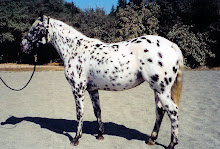
Appaloosa
The photo is of one of my horses who was almost 100 percent pure Appaloosa. I no longer raise horses due to expense and my upcoming 70th birthday.
Copyright 2009 Sharon Porter Moxley
Copyright 2009 Sharon Porter Moxley
Champion Race Horse
My mother bought me a cute little strawberry roan mare for my ninth birthday. She was a good kids horse and I rode her all over Whitethorn. I loved her but I longed for a horse that could run fast.
In 1964 I started raising Appaloosas. These horses had a marvelous history. Chief Joseph and his tribe raised Appaloosas and rode them in their mad dash for Canada trying to escape the US soldiers. The Indians were caught just miles from the border where Chief Joseph gave his eloquent surrender speech. "As the sun now stands I will fight no more forever."
Tragically the soldiers slaughter over a thousand of the tribes beautiful spotted horses. The rest of the horses scattered and they bred with the mustangs, draft horses, and other breeds. Eventually, horse lovers collected and bred the descendants of Chief Joseph's horses and formed the National Appaloosa Horse Club.
In 1984 one of my mares foaled a filly I named Cari Double. The next few years were the happiest of my life. I hired a trainer and Cari Double raced for two years becoming a National Champion Appaloosa race mare. What a thrill. I finally had my fast horse.
Copyright 2009 Sharon Porter Moxley
In 1964 I started raising Appaloosas. These horses had a marvelous history. Chief Joseph and his tribe raised Appaloosas and rode them in their mad dash for Canada trying to escape the US soldiers. The Indians were caught just miles from the border where Chief Joseph gave his eloquent surrender speech. "As the sun now stands I will fight no more forever."
Tragically the soldiers slaughter over a thousand of the tribes beautiful spotted horses. The rest of the horses scattered and they bred with the mustangs, draft horses, and other breeds. Eventually, horse lovers collected and bred the descendants of Chief Joseph's horses and formed the National Appaloosa Horse Club.
In 1984 one of my mares foaled a filly I named Cari Double. The next few years were the happiest of my life. I hired a trainer and Cari Double raced for two years becoming a National Champion Appaloosa race mare. What a thrill. I finally had my fast horse.
Copyright 2009 Sharon Porter Moxley
Thursday, March 12, 2009
Free Range
When I was living at Whitethorn (Thorn) there were very few fences resulting in what was called free range. My horse Stardust roamed the Whitethorn valley at will. This was great because I didn't have to feed her.
Today, here in Santa Rosa, I have paid up to several hundred dollars a month for each horse. Having a horse is no longer a choice for children who have parents with low or average income. It is a real shame. Having a horse was so helpful to my early development. I learned to take responsibility for my horse and I gained self-esteem for being able to ride and control such a big strong animal.
Interestingly enough horseback riding is almost exclusively a girls game. You see very few boys riding in horse shows. However, the males suddenly appear on the horse scene when they are in their early twenties. I don't know where they come from since most of them were absent as boys. But when they hit 21, they are out on the tracks riding race horses, roping cattle and riding in rodeos and Olympic equestrian events.
Copyright 2009 Sharon Porter Moxley
Today, here in Santa Rosa, I have paid up to several hundred dollars a month for each horse. Having a horse is no longer a choice for children who have parents with low or average income. It is a real shame. Having a horse was so helpful to my early development. I learned to take responsibility for my horse and I gained self-esteem for being able to ride and control such a big strong animal.
Interestingly enough horseback riding is almost exclusively a girls game. You see very few boys riding in horse shows. However, the males suddenly appear on the horse scene when they are in their early twenties. I don't know where they come from since most of them were absent as boys. But when they hit 21, they are out on the tracks riding race horses, roping cattle and riding in rodeos and Olympic equestrian events.
Copyright 2009 Sharon Porter Moxley
Wednesday, March 11, 2009
Wild Food of Whitethorn
Whitethorn was filled with many kinds of wild berries and nuts. Here is a partial list: huckleberries, blackberries, red caps, strawberries, hazel nuts, minors lettuce, and acorns. The acorns were a primary source of food for the indigenous Indians. They ground the acorns and then strained water through them to make an edible mash.
During the summer months, I used to graze on the food that was to be had for the picking. I also caught fish and roasted them on a small fire. I was afraid to eat the acorns, although I knew the Indians ate them, because I wasn't sure how to grind and wash them.
Copyright 2009 Sharon Porter Moxley
During the summer months, I used to graze on the food that was to be had for the picking. I also caught fish and roasted them on a small fire. I was afraid to eat the acorns, although I knew the Indians ate them, because I wasn't sure how to grind and wash them.
Copyright 2009 Sharon Porter Moxley
Tuesday, March 10, 2009
Yerba Buena
Yerba Buena (Good Herb) is a vine that grows wild in many places in California. My friends and I were always thrilled when we came upon this tasty plant with its delicious odor. It usually crawled in long vines beside trees and brush. It needed a bit of shade and a dash of sunshine to thrive. Once we had picked it we used to take it home and make a fantastic tea. A goodly dose of sugar made it perfect for our young taste buds
In Whitethorn we knew of many wild plants that were good for eating or drinking. I've always believed this knowledge had been passed down to the white settlers by the indigenous Sinkyone Indians.
Copyright 2009 Sharon Porter Moxley
In Whitethorn we knew of many wild plants that were good for eating or drinking. I've always believed this knowledge had been passed down to the white settlers by the indigenous Sinkyone Indians.
Copyright 2009 Sharon Porter Moxley
Subscribe to:
Posts (Atom)

 Posts
Posts


